Pages

Showing posts with label ProjectTips. Show all posts

Wednesday, April 15, 2026

Elevating Engineering Excellence: Top IEEE Project Directions for ECE (2025-2026)

Elevating Engineering Excellence: Top IEEE Project Directions for ECE (2025-2026)

In the rapidly evolving landscape of Electronics and Communication Engineering (ECE), the final year project serves as the ultimate bridge between theoretical principles—such as solid-state physics and signal processing—and real-world implementation. Today’s engineering standards, particularly those aligned with IEEE 2025-2026 guidelines, emphasize the integration of Wireless Communication, IoT, and Embedded Systems to solve complex global challenges.

To help students navigate these opportunities, we have organized the following high-impact project titles into logical domains of specialization.

1. Smart Agriculture and Environmental Sustainability

Agriculture is a primary focus for ECE innovation, utilizing Wireless Sensor Networks (WSN) and IoT to optimize resource management.

  • Design of the IoT Gateway for Agricultural Greenhouses: A system focused on long-term environmental monitoring using smart sensor interfaces.
  • WSN-Based Low Cost and Energy Efficient Framework for Precision Agriculture: An optimized approach to monitoring soil and crop health.
  • 5-in-1 Multipurpose Agricultural Robot (Agribot): A smartphone-controlled robotic vehicle designed for harvesting and field maintenance.

2. Next-Generation Wireless and Optical Communication

As the industry explores the optical spectrum for future communications, projects involving Li-Fi and satellite technology are becoming highly sought after by recruiters.

  • Li-Fi Based Wireless Communication System: Utilizing Visible Light Communication (VLC) for secure, high-speed data transfer.
  • Design of High-Performance LED-Based Integrating Sphere: Aimed at merging advanced illumination with communication capabilities.
  • Design of Rectangular Patch Array Antenna for Satellite Communication: A technical deep-dive into high-frequency aerospace transmission.

3. Healthcare and Biomedical Engineering

The intersection of electronics and medicine focuses on non-invasive monitoring and improving quality of life for the elderly and disabled.

  • Non-Invasive Remote Health Monitoring System Using VLC: Transmitting patient vitals securely through light-based signals.
  • Wearable, EEG-Based Massage Headband for Anxiety Alleviation: A sophisticated project utilizing brain-wave monitoring for mental health.
  • Smart Insole: A Wearable System for Gait Analysis: Focused on sports medicine and rehabilitative health tracking.

4. IoT and Smart City Infrastructure

With the rise of urban automation, projects that manage waste, water, and traffic through cloud-based data acquisition are critical.

  • Smart Cities for Future: Design of Data Acquisition Method Based on IoT: A foundational framework for gathering urban data.
  • IoT-Based Smart Garbage and Waste Collection Bin: An automated solution for optimizing municipal waste management.
  • Reconfigurable Smart Water Quality Monitoring System: Utilizing smart sensors to monitor environmental safety in real-time.

5. Robotics and Industrial Automation

Robotics allows students to showcase their skills in control systems and feedback loops, integrating mechanical actuators with intelligent signal processing.

  • Haptic Robotic Arm Using Flex Sensors and Accelerometers: A design focused on human-machine interaction for industrial or medical use.
  • Voice-Controlled Wheelchair Incorporated with Home Automation: Enhancing accessibility through integrated speech recognition and IoT.
  • Intelligent Line Follower Robot for Industrial Purpose: Demonstrating autonomous navigation in factory environments.

6. Security and Surveillance Systems

Security remains a top priority, with projects focusing on biometric authentication and automated identification.

  • Biometric System Based Electronic Voting Machine: Utilizing Raspberry Pi and fingerprint sensors for secure, transparent voting.
  • Fingerprint Prediction-Enabled Passport Authentication System: A high-protection security model for international travel protocols.
  • Smart Helmet for Accident Detection and Reporting: Using GPS and GSM technology to provide instant alerts during emergencies.

Strategic Project Selection

When selecting a project, it is essential to consider the three-part architecture of an electronic system: inputs (sensors), signal processing (microcontrollers/VLSI), and outputs (actuators). Whether you are specializing in VLSI design for power optimization or MATLAB-based image processing, your final year project is a statement of your professional capability and a vital addition to your career portfolio.

For The Year 2026 Published Articles List click here

…till the next post, bye-bye & take care

Tuesday, October 4, 2022

Essay Writing: What are Capitalising Titles mean?


One of the most important rules that you must remember when writing an essay is capitalising titles and headings. Many students make the mistake of not capitalising correctly, which can lead to a lower grade. Writers of academic paperwork usually face problems choosing the right title style and heading for their work. This becomes more difficult when you have to deal with an essay or research paper whose headings include titles and subtitles. When it comes to writing essays, the title and heading are two of the most important aspects. You want your title to be catchy and interesting so that readers will want to read more, while your heading should concisely state the main points of your essay. In order to capitalise on titles and headings correctly, you need to follow a few simple rules.

Which is Better Title: Case or Sentence Case?

Title case is better for printed newspapers and headlines. But, for writing for the web, sentence case is more appropriate because of how people read online and it’s more conversational manner. The most important thing to remember is consistency.


Capitalisation of Title: Basics

Unfortunately, some students believe it is okay not to capitalise the first word in a title and start writing words after it with lowercase letters. As a result, we get such texts as: "An investigation into the phenomena", "A study of juvenile delinquency", etc., which look bad and inappropriate. This mistake happens because of the lack of knowledge on how to write titles properly, so let's highlight some main rules you should know about capitalising them.

The first thing you need to know is that all words in a title are always capitalised except articles (i.e., "a", "an", "the"), prepositions (e.g., "of", "from"), etc.

E.g. How to Write Essay Introductions: 6 Tips

However, there are several types of titles, which differ according to their capitalisation forms. For instance, if the title has got its own subtitle or it includes another heading inside while being divided into two lines, then capitalises only the first letter of the first word and proper nouns:

E.g. How to Write Essay Introductions: 6 Tips on Writing an Effective Introduction"

If a title is divided into two lines, then capitalise all words but the first letters of every word after the dividing line:

E:g The Complications and Joys of Being a Teenager.

Besides, if titles include some dates or numbers, do not forget about capitalising them as well. For example: "Year 2012", "Fifth Grade", etc. However, it would help if you kept in mind that such cases are valid only when these details appear at the beginning of a title (before any comma). If they indicate some period (usually following colon), then do not capitalise on them: "From 1913-1945: The Great War".

E.g. How to Write Essay Heading: Formatting and Capitalisation

Now, let's see how a heading should look like properly. Unfortunately, there is no specific rule on headings capitalisation for essays or research papers, which means that writers can choose any style they want from below proposed by SMEs [Subject Matter Experts]: E:g "Writing an Argumentative Essay - Step By Step Guide or "Writing An Argumentative Essay - Step By Step Guide", etc. At the same time, you don't need to make a choice between these three styles right now, as all of them are correct and acceptable for academic paper writing. However, it is extremely important to pick the one which is used in your University or College for its students' work.

Considering these Expert’s Recommendations

1.       Capitalise all words and leave no space between them: "How to Write Essay Introductions: 6 Tips on Writing an Effective Introduction". At the same time, there must not be any punctuation signs at the end of a title (e.g., '.', '?' etc.).

2.       If titles are divided into two lines without any logical connections, then capitalise all words after the first line ending with comma except articles ("a", "an", "the"), prepositions ("of", "from"), etc. In this case, there should not be any punctuation marks at the end of a heading: E:gThe Complications and Joys of Being a Teenager.”

3.       If titles include some date or numbers, don't forget to capitalise them as well: "Year 2012", "Fifth Grade", etc.: "From 1913-1945: The Great War".

4.       Write only one space before the first letter in each word after a title ending with a colon or semicolon: E:gWriting an Argumentative Essay - Step By Step Guide; Writing An Essay Introduction."

5.       If you need to put commas inside your headings (mainly for titles divided into two lines or a line with two parts), then separate them from each other with a space. In fact, you can place commas wherever you want inside your headings but it is not recommended to do so as this might alter the readability of this part: "How to Write Essay Introductions - 6 Tips on Writing an Effective Introduction".

6.       You can also leave Headings without any punctuation marks at all:"Writing an Argumentative Essay - Step By Step Guide". However, the latter method is not preferable to use for academic works and has been used in old-fashioned publications only. Otherwise, don't forget that if your article includes some proper nouns (names of writers, books' titles etc.), then they must be capitalised according to the general rules of English language. For example: "Poe's Manuscript Clarissa".

How to Write Essay Headings in APA Style?

Now, let's take a look at how an essay or research paper heading should be written in American Psychological Association (APA) format. This is another common style that can be used for different academic works. If you are not sure whether your professor requires using this citation style, then visit APA Formatting and Style Guide by Modern Language Association (MLA). As for APA headings, they must include all crucial elements of a heading except numbers which are usually followed by full-stops, question marks etc.:

1.       Capitalise only the first letter of the first word.

2.       Leave no space between words, but if titles are divided into two lines, then there should be one space before the first letter after a title ending with colon or semicolon: "Writing an Argumentative Essay - Step By Step Guide; Writing An Essay Introduction".

3.       If you need to subdivide headings into several paragraphs, then leave these paragraphs without any indentations. However, you can use hanging indentations for different parts inside the article's main part (i.e., instead of the indented first line).

4.       Always put commas between headings and text they refer to: "How to Write Essay Introductions 6 Tips on Writing an Effective Introduction".

5.       If titles include some data, then they should be written in the form of a number followed by the abbreviated word "No.": 4th Grade, No. 1 (first) etc.: "From 1913-1945: The Great War".

6.       There is no need to use capital letters at all if you don't want to emphasise any word of the heading or its part. In this case, headings will look like bullet points divided into lines without any indentations and spaces between words: E:g How To Write Essay Introductions 6 Tips On Writing An Effective Introduction".

7.       Moreover, there must not be anything else but commas after each heading except for a special case when a heading of the last part of the text will be followed by a question mark or full-stop: "How To Write Essay Introductions? 6 Tips on Writing an Effective Introduction".

8.       Don't forget to include all important components of a heading in case your thesis includes some headings with multiple parts, divisions etc. Therefore, every component should be present except hanging indentations, which is rare nowadays.

9.       You can also use hanging indentations for different sections and subsections inside the main part of the work (without numbering): "Writing An Argumentative Essay - Step By Step Guide; Writing An Essay Introduction".

If you need to subdivide Headings into several paragraphs, don't worry about it and indent the first line as you do it for other paragraphs.

Get 1:1 Assistance for All Essay Queries

So, now you know that all headings (part and subheadings) must be numbered and written in a certain style, depending on the format your teacher requires. However, if you are unsure about correct formatting, ask your professor for help. Capitalising on titles and headings for essays is important to make your writing more commanding. Capitalising words also helps you write faster by giving the reader a visual cue that this is an important sentence or point in the paper.

This post hopes you will be able to take what it has given you to help your essay come alive. It is here to help you with your essay writing.

Compiled from:

https://www.indiaassignmenthelp.com/blog/everything-you-need-to-know-about-capitalising-titles-for-essay

…till next post, bye-bye and take care.

Monday, October 3, 2022

How To Write A Topic Sentence


“Well begun is half done.”

These words by Aristotle are no less than a new-age genius's hypothesis. Writing is about making the reader want to read the next sentence, the next, and the whole piece. But the catch is that you must intrigue your audience with a hook with an attractive or interactive start - whichever works for you.

A writer is an individual who finds writing more difficult than others.

Quote by Thomas Mann

Moreover, the first sentence of any paragraph is important to intrigue, inquire, or impress the reader. Hence, it is the “topic sentence” where you define the topic vaguely but effectively. The key to creating something is to know its why and how. So, read forth to know the answer to that question.

More About Topic Sentences

In brief, a topic sentence is the first sentence of any paragraph. Be it an essay or a report; the first sentence serves the purpose of introducing the theme. Regardless of the number of paragraphs, the first sentence of each paragraph of a written piece is a topic sentence as it introduces the gist of the following sentences.

For example, an essay consists of an introduction, body and conclusion. Each section isn’t divided with a heading or subheadings - unless needed - still, you can differentiate. How? Exactly why a topic sentence is important. However, the essay’s body section consists of many paragraphs, and it often gets difficult to distinguish ideas, but transitional words come in handy.

If the following paragraph contradicts the ideas mentioned in the previous paragraph, your topic sentence prepares the readers for a change of pace. It is often distracting for the reader to come across too much information or change the idea. Topic sentence writing eases the flow of ideas for the reader.

Also, writing a topic sentence isn’t as easy as you might think. How to start? What details to add? What to omit? Is too much information in your topic sentence, making it too long? Well, the next section discusses the composition of topic sentences in detail. Let’s learn with some examples, shall we?

Essay writing is a task that almost every student comes across regardless of the course they're pursuing. You may have a few incomplete ones waiting to be completed as well.

Academic writing is of many types - analytical, persuasive, descriptive, and critical, to name a few. You will use an appropriate writing style based on the type and theme of your academic assignment.

Many students fail to compose their essays effectively due to a lack of knowledge of technical lexicons or research troubles. Get assignment writing help from teachers, websites, SME [subject matter experts] if you face the same issue.

How to Write a Topic Sentence?

Now, the purpose of the topic sentence is clear. You may wonder, “I’ve been using topic sentences in my writing and didn’t know it.” Hence, the next step is to hone that skill. Here are three checks to compose the best topic sentences:

Check 1. Add a hook

Hook sentences are highly effective. It can be a quote or a fact, but it does get you intrigued to read further. Pick a suitable hook. Remember, every paragraph cannot begin with a hook. Just add it in the introductory paragraph for effect.

Check 2. Find a Middle ground

Everybody hates spoilers. A first sentence that bears it all is a spoiler per se. Avoid that. Also, only a little information gives way to disinterest. So, find a middle ground or a sort of lukewarm topic sentence that captures the reader but keeps them anticipating.

Check 3. Be Clear and concise

Lastly, your topic sentence must be clear and concise. Do not write, “the man was bitten by a black dog as the dog was fast asleep and he stepped on its tail” instead, try “, the dog bit the man, but why?” Wouldn't you want to find out why? That’s exactly what a topic sentence must do to make the reader want to continue reading.

Did you know that academic writing is based on features like conventions, word choice, presentation, ideas, voice, organisation, and sentence fluency?

So, if your topic sentence passes all these checks, you got the gist of it, and then you can move forth to learn through some examples. Topic sentences are a small but important part of your essay. The next section discusses a few examples of topic sentences.

What Are Some Examples of Strong Topic Sentence Writing?

Here are a few examples of topic sentences:

• Let’s look at some examples to understand it further.

• Also, considering the alternative might help.

• Ever wondered how to become a millionaire overnight?

• Are we prepared for the aftereffects of climate change?

• Many still believe in patriarchy, but the current generation is changing the trend with androgyny.

• As appealing as the idea of the universe seems, the evidential and logical proofs are still only hypotheses, so we still only know a little.

All rules of academic writing are universally applicable to maintain uniformity and consistency in every scholarly paper. Various forms of academic writing are developed from a common set of universally accepted rules.

While all topic sentences are transitions in nature, for a few exceptions, they are contradictory to the previous paragraph. It is effective to use a topic sentence when the next paragraph introduces a new topic drastically. Moreover, these are indeed transitional sentences. So, differentiating is the key.

Final Takeaways

Finally, you may find topic sentence writing easy, but doing it for hours and multiple makes you run out of ideas. On the other hand, you are benefitted from this as you gradually write better introductions in your essays. Differentiating your paragraphs is important to make it easier for the reader to understand. Moreover, the reader’s perspective should be kept in mind when developing your essay.

If you need help with your projects or get your work done independently. Keep writing and keep striving to get better each day. Getting help is easy and quick; it ensures good grades. This blog post can help you with drafting, writing, and proofreading through its content.

Compiled from:

https://www.indiaassignmenthelp.com/blog/how-to-write-topic-sentence

…till next post, bye-bye and take care.

Sunday, October 2, 2022

How to Write an Effective Report


How often do you come across writing a report for college and get stuck, clueless about what to do next? I am sure it must be happening all the time. As reports are crucial deliverables whose structure could be predefined, there are a lot more elements to them that cannot be determined beforehand. This blog post facilitates excellent report writing tips and has all the solutions to your problems related to effective report writing.

Report writing is something that relates a nonfiction label with the present facts or information about a specific topic, event, or happening. It is not a tough task, but students generally reflect on some facts and useful sections that should be done.

When students are interested in writing a report effectively but lack the knowledge to develop an appropriate topic, report writing comes into the role.

What exactly is the Report Writing?

Typically, report writing is a task where written documentation has been prepared for testimonials or accounts of some action. This task includes the observation and analysis of the subject. It just gives you the description or explanation of any situation or event.

In the current era of technology and advancements, report writing is a very common form of documentation that helps them very well. A report allows the writer to include the review, problem statement, sometimes solutions, and an obvious conclusion section. It includes a whole brief of the desired situation and a conclusion part.

The report must be prepared wisely and attentively because it can highlight the content you included, whether it has a positive or a negative impact. Make sure that the report has been prepared with real data and analysis. This can create great judgement when you take appropriate steps.

Are There Only Three Types Of Reports?

To have great knowledge about report writing, you need first to identify the type of report writing. Every context is different in terms of personal events or professional gatherings. It can be anything.

Hence, there are a few types of report writing depending on the aim you are collaborating with. The following are the main types that will help you to differentiate your purposes and help to select the desired one.

First Type: Academic report

Academic report writing concerns the study curriculum and standard education system. For example, any event or function at the university or college. Then this type of report writing will be included in academic report writing.

Second Type: Business reports

Business report writing can affect marketing growth. These are important and prepared with real facts and analysis of the situation. They include many variations, such as marketing reports, feasibility reports, SWOT analysis, internal memos, etc.

Third Type: Scientific reports

As the name suggests, these reports are related to scientific purposes. These reports include the deepest analysis with scientific proof from past experiences and are responsible for some upcoming technology or any problem catering for a solution. These reports include research papers and case studies, mainly in science journals.

Essential Elements required to be included in a Report Writing

Earlier, we discussed the various types of report writing. Now it’s time to discuss what elements should be included in the report writing to make it efficient. If there are no requirements to be included, but if you see them in schools, universities, companies, labs, or any professor, they have their criteria or format to do the same thing differently to make it unique.

Hence, it is required to at least add the following elements in the report writing to at least satisfy the basic needs.

Element One: Main Title Page

When you start writing the report, the first and main thing you should consider is creating a desired title for the subject. This will create an impression on the reader.

Element Two: Table of Content Specified

It is the best thing that even every school student follows. The topics that you are including are sure to specify the topics.

Element Three: Allocate Page Numbers

There is no need to specify this, but it is necessary because these small elements greatly impact your report writing. Page numbers allow readers to continue with the content if they get busy with other stuff.

Element Four: Make Headings and Subheadings

Creating headings and subheadings not only improves the look of the document but also provides a clear understanding of the topic being discussed in the context.

Element Five: Add Citations

Citations are important because you are taking any source, so giving them credit is also necessary in this case. If you are afraid of plagiarism or copyright, include citations.

Element Six: Write an appropriate bibliography

After the whole writing task, the only thing left is to add an appropriate bibliography. Currently, there is various software that is useful for citations and bibliography. So, use them if you are a beginner.

7 Steps to Write an Effective Report

Step One: Be Sure With The Aim

For positive outcomes from report writing, you must first think about your report's objective. It can take a long time but will produce effective results.

Step Two: Knowledge Of The Targeted Audience

Whether you are writing a business or an academic report, the most important thing you should remember is to target the audience and engage them with your ideas. Attention is one metric that makes a significant difference in marketing analysis or research. Analyse some regardings and surely mention them while representing the report, such as tone, your context voice, data gathering, and graphical usage.

Step Three: Appropriate formatting

While writing a report or any other document, formatting is where people can humiliate your writing skills because for a writer, proper formatting and looks matter in front of an audience.

Step Four: Collection of Valid facts

After defining the aim, you must ensure that you have used the appropriate and real facts for business analysis or scientific purposes.

Follow The Basic Structure Of The Report

Good report writing includes the following four phases:

Phase One: Executive Summary

Starting with a summary is like starting with an abstract in an article. It includes all the data that you have used in the report in a concise form.

Phase Two: Introduction

Before representing real data and information, create an environment and specify the subject so the reader can easily understand what is happening.

Phase Three: Body

The body includes the main data and the problem statement, and what issues have been found in the subjects. It is considered to be a bit longer than the other phases.

Phase Four: Conclusion

Finally, conclude your topic with strong and valid arguments.

Second Last Step: Understanding After Reading

After writing the report, read it once to check its flexibility and understanding. Think from the perspective of the reader, and you will be able to find the flaws.

Final Step: Rechecking and Editing

No report or any document is correctly formed in one way. Hence, rechecking is a must for efficient work.

Compiled From:

https://www.indiaassignmenthelp.com/blog/how-to-write-effective-report

…till next post, bye-bye and take care.

Saturday, October 1, 2022

7 Helpful Steps To Find Ideas For Your Engineering Project

“The crux of the design process is creating a satisfactory solution to a need. The need may be to improve an existing situation or to eliminate a problem. In any case, it is what engineering is all about—using knowledge and know-how to achieve a desired outcome.”

--Lee Harris Berger, Engineers Manship… The Doing of Engineering Design


Engineering projects involve creative problem solving, and they are not hypothesis testing. Each engineering design, software application or device project should have a clear engineering goal which can fit the following model statement:

“The design and construction of a (engineered product) for (target user) to do (some useful function).”

I know coming up with an interesting and creative design or engineering project can be a difficult and daunting task. In this short blog post, I will show you an ideation process that can help you be more creative!

First Step: Design Problem Must Be Defined

Firstly, take a step back and make sure you have a clear understanding of the problem. You need to be able to empathise with whatever target user you choose. It's important to put yourself in their shoes and understand what their day-to-day looks like. When you do this, you can then begin to identify what problems they may face, and therefore, better understand the design problem.


Second Step: Use An Empathy Map

One way to summarise what the user may experience, is to create an Empathy Map. This is a table divided into quadrants, with each section labelled based on what the user may think and feel, see, hear, say and do. This can then be referred back to, keeping the project focused around the user and their issue being solved.

Third Step: Time To Write Problem Statement

Using your Empathy Map, create a short Problem Statement of the exact issue you're trying to solve, clearly establishing a brief.

A good Problem Statement should include:

·      What the existing problem is

·      The drawbacks of the current problem

·      Why the problem is so important

·      How the problem impacts the target user


Fourth Step: Process of Ideation

The ideation stage is all about taking what you have produced so far and creating possible solutions. Using your problem statement as a guide, you will come up with a wide variety of ideas before finding the best possible solution for the user.

Fifth Step: Brainstorming for feasible idea

Write your problem statement in the middle of the page and start recording ideas for possible solutions. Remember, when brainstorming always go for quantity. Don't be afraid to write down outlandish and bizarre ideas, as the goal of this brainstorming session is to generate as many ideas as possible to choose from.

Doing this effectively can result in a huge number of different solutions, so remember to set a time limit for this activity, making sure you remain focused on the task.

Sixth Step: Selecting ideas From List

There's a variety of different methods for filtering out bad ideas, but we will be going over the Four Categories method. As the name suggests, you sort your ideas into 4 categories;

1.       Most rational,

2.       Most delightful (to your user),

3.       Darling (most innovative) and

4.       Long shot (most unrealistic).

Using the ideas you generated on your mind map, begin sorting them into each category (you can place an idea in more than one section). Using this, you can clearly see which ideas are innovative, but still realistic enough to fit your brief.

Last Step: Take away

Selecting a project can seem intimidating, but pick something that you find interesting and innovative, while still being realistic and able to fulfil the brief.

Sources For Further Reading:

https://trainingindustry.com/articles/content-development/engaging-the-learner-with-design-thinking-stage-1-empathize/

https://www.interaction-design.org/literature/article/stage-2-in-the-design-thinking-process-define-the-problem-and-interpret-the-results

https://www.nngroup.com/articles/empathy-mapping/

https://science-fair.org/students-parents/winning-engineering-projects/

https://my.pblworks.org/resource/blog/how_do_you_come_up_with_these_project_ideas

https://www.interaction-design.org/literature/article/how-to-select-the-best-idea-by-the-end-of-an-ideation-session

...till next post, bye-bye and take care.

Saturday, May 14, 2011

Final Year Project Report Writing Tips

Dear Reader:

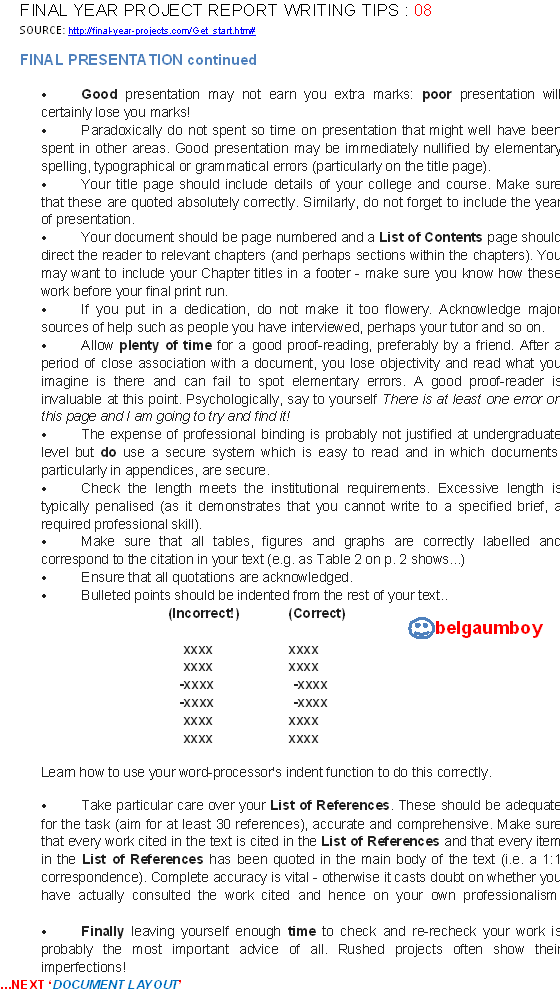
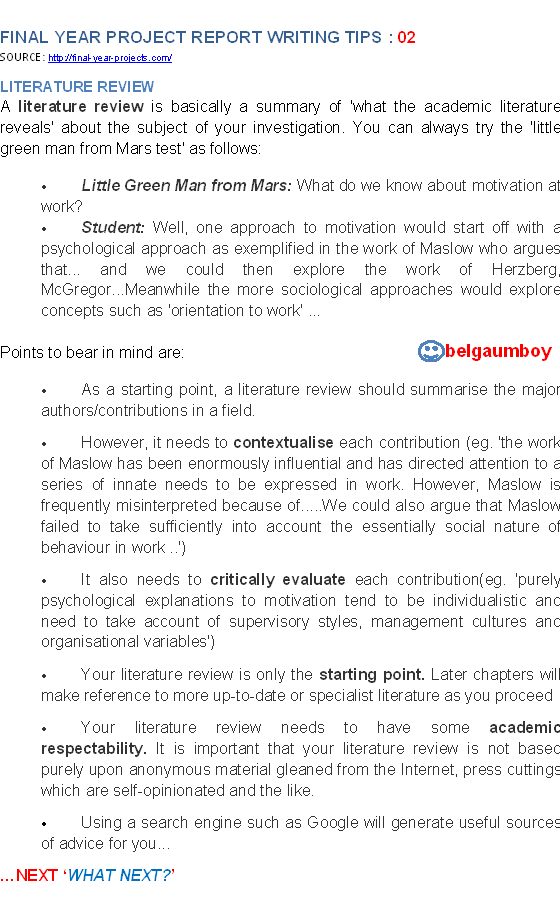
This page gives Final Year Engineering Project Report WritingTips [in 9 sections] as follows.

Keep visiting this page for latest Final Year Engineering Project Report Tips . For till now list click ProjectTips label.

...till next post bye-bye and take care.

Tuesday, May 10, 2011

Final Year Project Report Writing Tips

Dear Reader:

This page gives Final Year Engineering Project Report WritingTips [in 9 sections] as follows.

Keep visiting this page for latest Final Year Engineering Project Report Tips . For till now list click ProjectTips label.

...till next post bye-bye and take care.

Friday, May 6, 2011

Final Year Project Report Writing Tips

Dear Reader:

This page gives Final Year Engineering Project Report WritingTips [in 9 sections] as follows.

Keep visiting this page for latest Final Year Engineering Project Report Tips . For till now list click ProjectTips label.

...till next post bye-bye and take care.

Monday, May 2, 2011

Final Year Project Report Writing Tips

Dear Reader:

This page gives Final Year Engineering Project Report WritingTips [in 9 sections] as follows.

Keep visiting this page for latest Final Year Engineering Project Report Tips . For till now list click ProjectTips label.

...till next post bye-bye and take care.

Thursday, April 28, 2011

Final Year Project Report Writing Tips

Dear Reader:

This page gives Final Year Engineering Project Report WritingTips [in 9 sections] as follows.

Keep visiting this page for latest Final Year Engineering Project Report Tips . For till now list click ProjectTips label.

...till next post bye-bye and take care.

Tuesday, April 26, 2011

Final Year Project Report Writing Tips

Dear Reader:

This page gives Final Year Engineering Project Report WritingTips [in 9 sections] as follows.

Keep visiting this page for latest Final Year Engineering Project Report Tips . For till now list click ProjectTips label.

...till next post bye-bye and take care.

Friday, April 22, 2011

Final Year Project Report Writing Tips

Dear Reader:

This page gives Final Year Engineering Project Report WritingTips [in 9 sections] as follows.

Keep visiting this page for latest Final Year Engineering Project Report Tips . For till now list click ProjectTips label.

...till next post bye-bye and take care.

Thursday, April 14, 2011

Final Year Project Report Writing Tips

Dear Reader:

This page gives Final Year Engineering Project Report WritingTips [in 9 sections] as follows.

Keep visiting this page for latest Final Year Engineering Project Report Tips . For till now list click ProjectTips label.

...till next post bye-bye and take care.

Sunday, April 10, 2011

Final Year Project Report Writing Tips

Dear Reader:

This page gives Final Year Engineering Project Report WritingTips [in 9 sections] as follows.

Keep visiting this page for latest Final Year Engineering Project Report Tips . For till now list click ProjectTips label.

...till next post bye-bye and take care.

Wednesday, April 6, 2011

Final Year Project Report Writing Tips

Dear Reader:

This page gives Final Year Engineering Project Report WritingTips [in 9 sections] as follows.


Keep visiting this page for latest Final Year Engineering Project Report Tips . For till now list click ProjectTips label.

...till next post bye-bye and take care.

Saturday, April 2, 2011

Final Year Project Report Writing Tips

Dear Reader:

This page gives Final Year Engineering Project Report WritingTips [in 9 sections] as follows.


Keep visiting this page for latest Final Year Engineering Project Report Tips . For till now list click ProjectTips label.

...till next post bye-bye and take care.

Monday, March 28, 2011

Final Year Project Report Writing Tips

Dear Reader:

This page gives Final Year Engineering Project Report WritingTips [in 9 sections] as follows.


Keep visiting this page for latest Final Year Engineering Project Report Tips . For till now list click ProjectTips label.

...till next post bye-bye and take care.

Tuesday, October 26, 2010

Project Tips: Significance of Final Year Projects

Dear Reader:

This page gives Latest Engineering Project Tips as follows. 

Keep visiting this page for latest Engineering Project Tips. For till now list click ProjectTips label.

...till next post bye-bye and take care.